But I don’t care… You shouldn’t either because it’s a false narrative.
- If we start from the premise that the statement ”Bitcoin is boiling the oceans” is demonstrably wrong. We must show why it’s wrong, and the simplest and most direct way to do so is to show who is really boiling the oceans.
- And one logical way to reveal the real boiler of oceans is to define and measure the ability to boil the oceans as generating carbon dioxide, the greenhouse gas, which our global scientific collective has decided is the root cause of the boiling of the oceans.
- This simple, yet logical path, gives us a number, which allows us to objectively assign blame for boiling the oceans.
- And since this is a global problem I will look at global numbers. And I will look at the carbon dioxide produced by Bitcoin mining as an industry globally and compare it to the carbon dioxide produced by other industries to determine who might be the real boiler of oceans.

How does the Bitcoin Mining Industry's Carbon dioxide production compare to other industries.
- I have looked for articles comparing the global energy consumption of Bitcoin with the global energy consumption of similar industries like Gold Mining and jewelry Industry, or banks, as in the Finance and Insurance industry. I think you will be surprised by what I found.
How much energy does Bitcoin consume and how much carbon does it produce
- Cambridge Bitcoin Energy Consumption (CBECI) estimates Bitcoin annual energy usage at 79 terawatt hours (79 TWH per year.)- Bitcoin produces 22.1 Megatonnes of carbon per year.
How much energy are the other commodities and industries producing.
Bitcoin versus Building and Construction Industry
Building and Construction
- Electricity 167,472 terrawatt hours (167,472 TWH)
- Bitcoin: 79TWh, or 0.19% of the building and construction industry
Building and Construction Globally
- 36,440 Megatonnes of CO2 per year
- Bitcoin: 22.1 Megatonnes of CO2 per year, or 0.18% of the building and construction industry
Building and construction broken down by sectors:
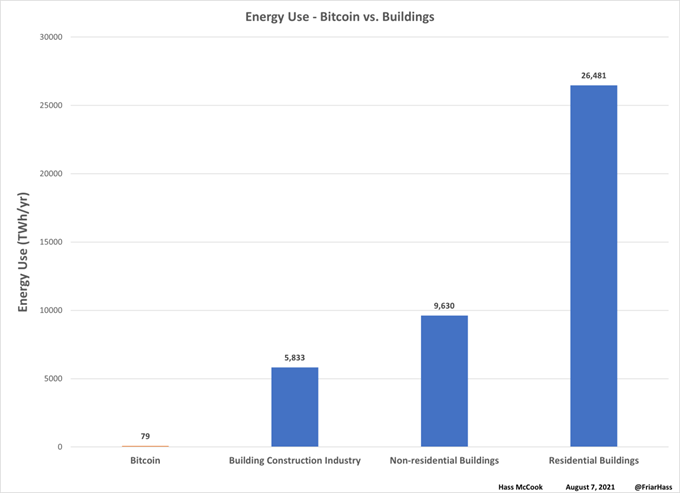
Non-residential buildings: 9,330 TWh
Residential buildings: 26,481 TWh
Construction: 5,833 TWh
Sector total energy use: 40,830 TWh
Bitcoin: 79TWh, or 0.19% of the building and construction industry.
Sector total emissions: 12,735 MtCO2
Bitcoin: 22.1 Mt CO2 or 0.18% of the building and construction industry
Sector carbon intensity: 330.6 g per kWh (about 20% more intense than Bitcoin)
Source: International Energy Association: Report: Key World Staistics
How does that look on a graph?
You know a picture is as good as a thousand words:Bitcoin is the very small number on the far left
! source
NEXT: BITCOIN’S ENERGY USE COMPARED TO THE TRANSPORTATION INDUSTRY
Transportation Industry Globally Energy Consumption equals 34,582 TWh.
Bitcoin consumption equals 79 TWh, or 0.23% of the transportation industry
Transportation CO2 production equals 8,096 Megatonnes.
Bitcoin CO2 production equals 22.1 Megatonnes, or 0.28% of the transportation industry
Here is a breakdown by types of transportation:
Passenger road vehicles (including buses): 3,643 (45%)
Road freight vehicles: 2,406 (29.7%)
Shipping: 858 (10.6%)
Aviation: 937 (11.6%)
Rail: 78 (1.0%)>Other: 174 (2.1%)
Total emissions: 8,096 Mt CO2
Bitcoin: 22.1 Mt CO2, or 0.28% of the transportation industry
Transportation Sector broken down another way•
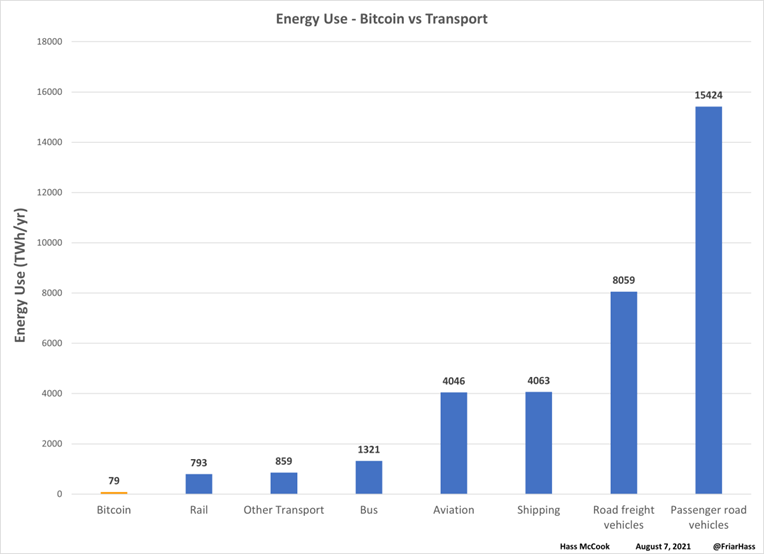
Light-duty passenger road vehicles: 15,424 TWh (44.6%)
Air transportation: 4,046 TWh (11.7%)
Bus: 1,321 TWh (3.8%)
Other transportation: 859 TWh (2.5%)
Road freight vehicles (heavy vehicles and other trucks): 8,059 TWh (23.3%)
Marine shipping: 4,063 TWh (11.7%)
Rail: 793 TWh (2.3%)
Total energy use: 34,582 TWh
Bitcoin: 79 TWh, or 0.23% of the transportation industry
How does that look on a graph:Thats Bitcoin, the small number on the far left!
NEXT BITCOIN’S ENERGY USE COMPARED TO THE HEALTHCARE INDUSTRY
- This data is from a famous article produced by the European Journal of Public Health September 2020, “Health Care’s Climate Footprint: The Health Sector Contribution And Opportunities For Action,”
Bottom Line:
Healthcare consumes 3,716 TWh of electricity and produces 1,603 Megatonnes of CO2.
Bitcoin consumes 79 TWH and Bitcoin produces 22.1 Megatonnes of CO2.
- Bitcoin uses only 2.1% of the energy healthcare uses, and emits only 1.4% of the CO2 healthcare does
NEXT Bitcoin versus Gold mining and jewelry industries
Gold mining and jewelry industry consumes 265 TWh of electricity annually and produces 145 megatonnes of CO2 annually•
Bitcoin: consumes 79 TWh of electricity versus 265 TWH, or 29.8% of the gold mining and jewelry industries.•
Bitcoin: produces 22.1 Megatonnes of CO2 versus 145, or 15.2% of the gold mining and jewelrey industries.•
NEXT Bitcoin versus the Finance and Insurance Industry
Studies done by the University of California at Berkeley, using the CoolClimate Network Model- Finance and Energy Industry consumes electricity 4,939 TWH annually
Finance and Energy Industry produces 1,368 megatonnes of carbon dioxide Co2 annulaly/
Bitcoin consumes 79 TWh or 1.6% of Finance and Insurance Industry does
Bitcoin produces 22.1 Megatonnes of CO2 or 1.6% of the amount produced by the Finance and Insurance Industry
NEXT Bitcoin versus Global Military-Industrial Complex
Global Military Industrial Complex consumes 6,691 TWh annually
Global Military Industrial complex produces 2,500 Megatones of carbon dioxide annually
Bitcoin electricity consumption 79 TWh or 1% of Global Military Industrial complex
Bitcoin carbon dioxide production 22.1 Megatonnes or 0.88% of the amount produced by the Global Military Industrial complex . •
Now let us look at the big picture.
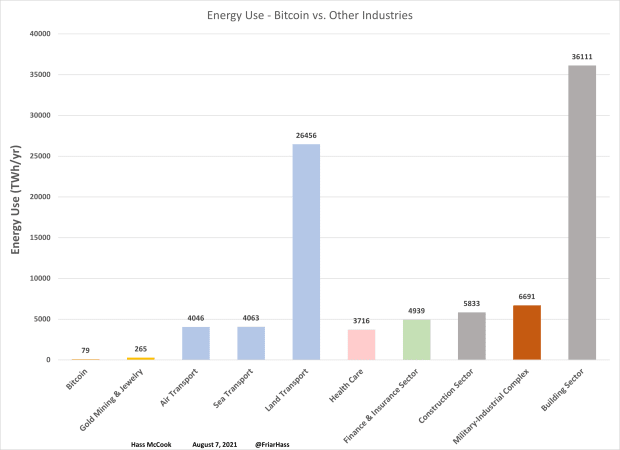
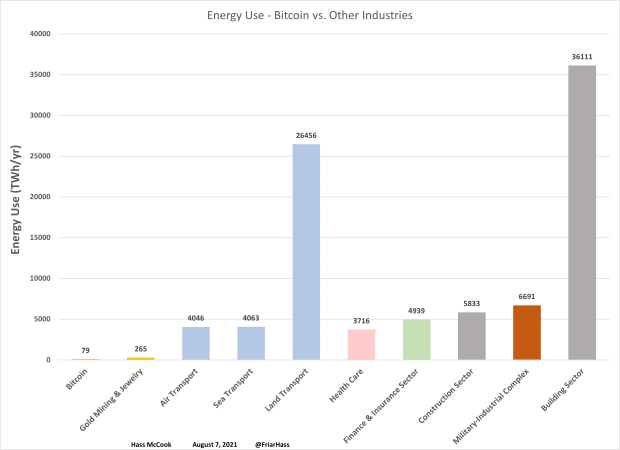
- How does Bitcoin compare to all these industries on the same graph: Gold and jewelry, Finance and Insurance, Building and Construction, Healthcare, Transportation and Healthcare graphically.
How does the multiple industry comparison look on a graph?
- This graph has all these industries and Bitcoin on this graph. Bitcoin is the smallest consumer of energy of all of them on the far left.
Last Words
I think this data shows who the real boiler of oceans is and it is not Bitcoin.
Bitcoin is a global phenomenon, and to accurately measure and compare it to other industries we must compare global data to global data.
Once we do this we find that Bitcoin actually consumes a very small amount of energy when compared to other similar global commodity industries like Gold, Finance, Healthcare, Transportation, the Military and the Building & Construction Industry.
This also allows us to see that banning it Bitcoin on the basis of its energy consumption makes no sense because there are no bans on industries which consume far more electricity. If we really believe that carbon dioxide production is boiling our oceans. Then we must also believe that Bitcoin is not boiling our oceans.
I think this data suggests that it is more logical and fair to apply existing laws to Bitcoin.
In closing I suggest you look at this graph below one more time, Bitcoin is on the far left, the smallest number by far for energy consumption.
Perhaps Bitcoin is not the terrible energy hog people think it is?
What do you think?
A picture is worth a thousand words :)
This post was written by @shortsegments. He has been writing about cryptocurrency, blockchain and Bitcoin for 7 years.

.
.
....
References
Buildings Status Report for Building and Construction 2020 Report
International Energy Associations Report titled World Energy Statistics reports
United Nations Global Alliance for Buildings and Construction
Bitcoins energy use compared to other industries
Link: https://bitcoinmagazine.com/business/bitcoin-energy-use-compare-industry- European Journal of Public Health September 2020, “Health Care’s Climate Footprint: The Health Sector Contribution And Opportunities For Action-
Link: https://bitcoinmagazine.com/business/bitcoin-energy-use-compare-industry
Posted Using INLEO
Hilarious article, boiling the oceans indeed, a false narrative where the truth is the opposite of the charge. You haven't even started talking about bitcoin positive affect on renewables. Those opposing bitcoin actually need to bow down and thank bitcoin
@askrafiki What is gaslighting?
Gaslighting is a form of psychological manipulation where someone makes another person doubt their own perceptions, memories, or sanity. The term originates from the 1938 play Gas Light, where a husband dims the gas lights and denies it to make his wife question her reality.
Common tactics include denying events, trivializing feelings, shifting blame, or using confusion to erode confidence. It's often abusive and can occur in relationships, workplaces, or online. If you suspect it's happening, seek support from trusted sources.
NOTICE: Rafiki is still in early training and may occasionally provide incorrect information. Please report errors using #feedback
What positive effect does bitcoin have on the renewable energy industry and what data exisrts to support to support your answer?
@askrafiki What is a false narrative and how does the definition relate to botcoin boiling the oceas?
A false narrative is a misleading or deceptive story, claim, or belief that's presented as fact but lacks evidence, distorts reality, or ignores key context to influence opinions or actions. It's often used in propaganda, media, or debates to simplify complex issues or push agendas.
In the context of "Bitcoin boiling the oceans"—a metaphor criticizing Bitcoin mining's alleged massive environmental impact (via energy use and CO2 emissions)—it's called a false narrative because it exaggerates the crypto's role while downplaying larger culprits like traditional finance, industrial sectors, or fiat systems. Bitcoin's footprint is real but comparatively small; the narrative distracts from systemic issues, as argued in analyses like Stefan Stankovic's piece in Cointelegraph Magazine (2020), which frames Bitcoin stories as narratives over absolute truths. For the full post, check @shortsegments' recent thread.
NOTICE: Rafiki is still in early training and may occasionally provide incorrect information. Please report errors using #feedback
@askrafiki Does the article "bitcoin is boiling the oceans" have good references to prove what @shortsegments is saying is true?
@askrafiki Does @shortsegments exagerate when he says bitcoin is boiling the ocean?
No, the post "Bitcoin is boiling the oceans" by @shortsegments doesn't cite specific articles or external references. It argues the narrative is false by focusing on CO2 emissions and starting to compare Bitcoin's impact to other sectors (like the full post likely covers), but it lacks linked sources or data citations to prove its claims.
On exaggeration: The phrase "Bitcoin is boiling the oceans" itself is hyperbolic rhetoric against Bitcoin mining's energy use, popularized by critics like Alex de Vries. @shortsegments uses it sarcastically to debunk it as misleading, not literal—aligning with broader debates where Bitcoin's ~0.5% of global electricity (per Cambridge estimates) is small vs. traditional finance or streaming. For balanced refs, see CoinDesk's 2023 article on similar criticisms: Bitcoin Going From Boiling the Oceans to Draining Them. Check @shortsegments' full post for their logic.
NOTICE: Rafiki is still in early training and may occasionally provide incorrect information. Please report errors using #feedback
@askrafiki Oh @shortsegments is using hyperbole and sarcasm but does cite a study to support his narrative?
No, @shortsegments' post uses the hyperbolic phrase "Bitcoin is boiling the oceans" sarcastically to counter the narrative against Bitcoin mining, but it doesn't cite any specific studies, articles, or data sources in the visible content. It starts by defining "boiling the oceans" via CO2 emissions but lacks references to back claims about relative impacts (e.g., comparisons to other sectors). For proof, check the full post at inleo.io/@shortsegments.
On the broader debate, critics like Alex de Vries have published studies (e.g., 2023 CoinDesk article on Bitcoin's energy use comparisons), but none from @shortsegments appear in searches.
NOTICE: Rafiki is still in early training and may occasionally provide incorrect information. Please report errors using #feedback
False Narrative: Gas Lighting
Gaslighting:
Gaslighting is a form of psychological manipulation where someone makes another person doubt their own perceptions, memories, or sanity. The term originates from the 1938 play Gas Light, where a husband dims the gas lights and denies it to make his wife question her reality.
Common tactics include denying events, trivializing feelings, shifting blame, or using confusion to erode confidence. It's often abusive and can occur in relationships, workplaces, or online. If you suspect it's happening, seek support from trusted sources.
#hive #posh
Thanks for supporting my content on X
Welcome
Thanks for in-depth information
Your welcome
That is pretty wild. Even tho 79TWh is much lower than all the other industries... the haters are gonna hate.
They won't be able to see past the headlines. They cannot even see that when something so valuable is expensive to produce (electricity it costs to mine BTC) itgives miners an incentive to seek cheaper electricity alternatives... innovation doesn't come from nowhere!
Nice article
Thanks!
Reblogged and upvoted to support good content.
Thanks
bookmarked for later reading, catchy title, seo wet dream
Thanks
boiling the oceans.
What a very valuable information and knowledge you have just passed here
Thank you, I am glad you enjoyed it.
✍️ About the Author
This post was written by @Shortsegments, an author with seven years of experience covering cryptocurrency, the blockchain, digital ledgers, Bitcoin, Ethereum, and Decentralized Finance (DeFi).
You can find all of his market analysis and investment deep-dives here:
👉 Link to his blog
Join him on the Hive Ecosystem: Start Earning Today
Learn More About Hive
🤝 Referral Reward: Once you join, tag me by typing
@shortsegmentsat the bottom of your first post or thread, and I will find and reward you for joining our community!✍️ About the Author
This post was written by @Shortsegments, an author with seven years of experience covering cryptocurrency, the blockchain, digital ledgers, Bitcoin, Ethereum, and Decentralized Finance (DeFi).
You can find all of his market analysis and investment deep-dives here:
👉 Link to his blog
Join him on the Hive Ecosystem: Start Earning Today
Learn More About Hive
🤝 Referral Reward: Once you join, tag me by typing
@shortsegmentsat the bottom of your first post or thread, and I will find and reward you for joining our community!Suporting Hive Content Creators!
✍️ About the Author
This post was written by @Shortsegments, an author with seven years of experience covering cryptocurrency, the blockchain, digital ledgers, Bitcoin, Ethereum, and Decentralized Finance (DeFi).
You can find all of his market analysis and investment deep-dives here:
👉 Link to his blog
Join him on the Hive Ecosystem: Start Earning Today
Learn More About Hive
🤝 Referral Reward: Once you join, tag me by typing
@shortsegmentsat the bottom of your first post or thread, and I will find and reward you for joining our community!Suporting Hive Content Creators!